
It won't stand still!
On Mohawk Games' Old World, pushing updates and reviewing games

Once upon a time, reviewing computer games differed little from reviewing books or movies. The game was published in its final form on a certain date, at which point it assumed its final form, the form in which the public would come to know it and in which history would remember it. As a reviewer summarizing it for an uninformed readership or a critic attempting an in-depth analysis, this gave you a fixed object on which to base your work.
Back then, of course, computer games were published on physical media, as were books and movies. When you bought a copy, you got something that you could hold in your hand and keep in your private space. If the author, publisher, studio or developer or whomever changed their minds later and wanted to alter something, they’d have to make and distribute new physical copies at the same cost as the initial publication, or go after every single copy sold so they could mark out the deletions and scribble in the corrections.
The death of physical media and the rise of direct download as the main method for distributing software changed all that, as I discussed here. Now, it is a simple thing to distribute debugged, improved or even just modified versions of a digital game after publication. You can do it as often as you like because you can take it for granted that your customer has some kind of digital lifeline to you, whether it be Steam or some other medium, like the air line in an old-fashioned diving suit.
I began to wonder how this affects game reviews after I started playing Mohawk Games’ Old World last year. I found Old World an enjoyable piece of work, a conventional 4x strategy game that kind of melds the Ancient and Classical eras. You can play as Classical Greece, or the Hittite Empire, or Imperial Rome or Pharaonic Egypt, as all coexist comfortably in the same historical space. They’re all old, right? The mechanics are not terribly complex and the time frame is limited, as the tech tree doesn’t advance beyond Late Antiquity. It’s not as ambitious as Civilization VI or Humankind in that sense, but because of that it also feels more manageable. The unit density is quite moderate considering that it was designed by Soren Johnson, who also designed the unit-dense Civilization IV.
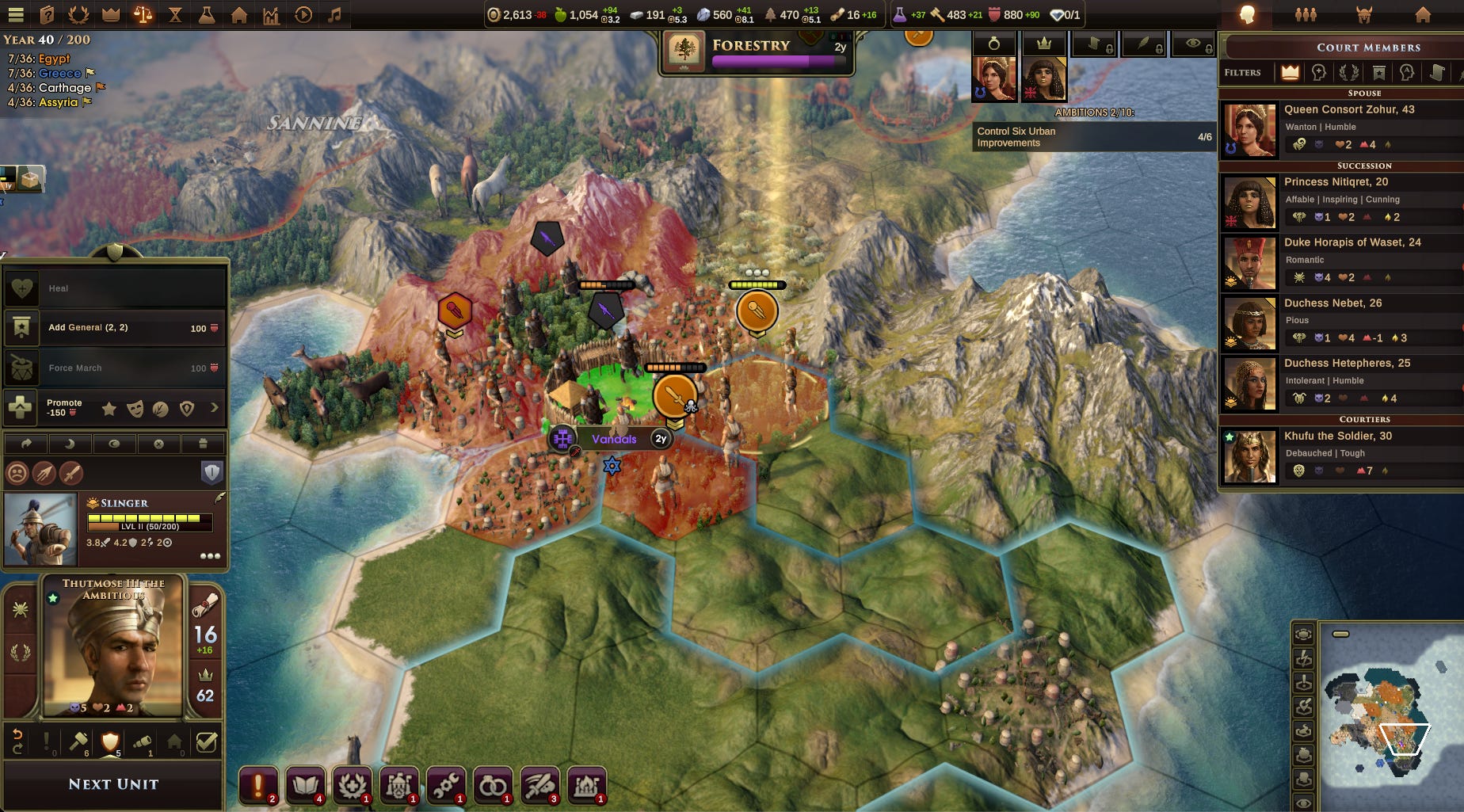
If turn-based 4x strategy is your thing, I recommend Old World with few qualifications. Think of it as Civilization meets Crusader Kings III, since it splices in dynastic roleplaying not unlike what you find in the latter.
With all that being said, however, I am surprised by how often the game has been updated since I bought it — and not just to fix bugs (which were all minor, at any rate) and tweak functionality. Enough changes to play balance and difficulty level have been made at various points over the past year that the game feels somewhat different from what I remember from the last time I played before that update was released, much less when I first bought and played it. The Crusader Kings-like roleplaying mechanics can also be tinkered with endlessly, as the development team swaps in and out random (and not-so-random) events, pretty much at their whim.
The screenshot above comes from my current play through, which I started just a few days ago. It is the first time I have played since the last major update. So far, about 1/3 of the way through, it seems like Courtiers are almost impossible to come by compared to the last version; Courtiers can be tasked with tutoring royal heirs of a certain age, thus buffing their stats and abilities before they inherit the throne. Members of the royal family seem to sicken and die more often. For the first time ever, my monarch was, without warning and provocation, usurped and killed by her heir. I don’t recall this ever happening to me before. All of these things can affect your strategic planning, and so they throw you for a loop if you aren’t expecting them.
All of this is well and good. I respect Mohawk’s commitment to improving the game for those of us who have already paid our money for it — or at least, to changing it enough so that we can’t settle into a boring groove, knowing sure-fire how to win every time out. On the other hand, it is disappointing when they remove a detail that I really liked, such as the random event that allowed you to recruit a sort of holy fool NPC as a courtier, much to the dismay of the rest of the court. It appears that the devs took him to the basement and garroted him with the first update, because I haven’t encountered him since.
However, it does raise a question in my mind: How do you write an authoritative review of a game that is, by intention, always in a state of flux? A review fixes a game at a moment in time and ideally, as a written artifact, it should have some value for those who want to learn something about the game even when it is no longer all that new. How much value does that review still have if updates have changed the game so much that some of that information no longer applies? Journalism has always had a short shelf-life, but this just squeezes its relevance even tighter. Has the digital game review become obsolete?
In the future, might push updates do the same to music and movie reviews? Music and movies are now distributed as digital files. What if an artist has second thoughts post-publicaton? What if a studio re-edits a movie on the fly in response to initial audience reaction. What if it becomes practical do so multiple times after the initial release? I don’t see physical books disappearing anytime soon so I don’t think this will happen to book reviews. But once e-readers dominate the book market and physical books become the domain of Luddites and snobs, the same is bound to happen. The best a reviewer can say at that point is, “This is my advice today, at the time that I am writing. Tomorrow, you and I and everyone else who cares may wake up to a different reality.”
[The paywall approaches, though it probably won’t arrive for another couple of months. After it goes up, a post like this will probably go behind it. It’s not an in-depth review, nor is it wholly a deep-think essay, but it goes on long enough and combines enough of each in doing so, so that it would qualify as a pay-walled post. Perhaps I will at some future point write an in-depth review of Old World, or at least a tips-and-hints essay — only to have it invalidated by the next update, of course.]
Unfortunately, as a physical copy only Gamer, and one who buys magazine games as well as standard hex and chit games, I’m used to errata being released in either later issues of magazines, specifically Strategy & Tactics, or thru an industry magazine such as C3I. I don’t ever see e-releases as ever being the dominant format for books, games, movies, although Hollywood seems to be, shortsightedly, trying for that regarding films.
Physical games have advantages of allowing someone to disconnect from the ever present noise of society and to encourage social interaction. There’s also the availability aspects. Not everyone has a regular source of electricity, so physical books and games will remain in heavy use there.
I agree that time stamping reviews of electronic media might become the norm based on “on this date, with this version”.